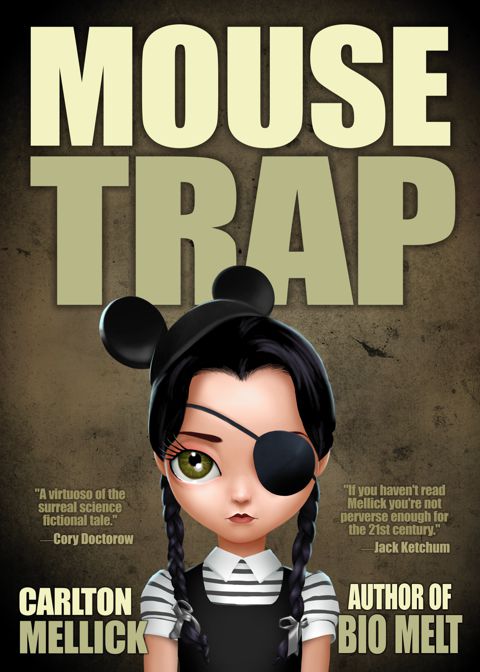
Cover for “Warrior Wolf Women of the Wasteland”

Posted in Bizarro Books on July 27, 2009 by carltonmellick

The book isn’t coming out until later in the year, but here’s a look at the cover. What do you think?

Slayer

I consider this book my werewolf book, only it has a different werewolf mythology. Instead of temporarily turning into wolves on the full moon, these werewolves turn slightly but permanently more wolf-like every time they have sex. Set 100 years after the apocalypse, this book is like Road Warrior with werewolf girls.

Luck Favors the Bold

Posted in Writing Related on July 24, 2009 by carltonmellick

I’m staying on the marathon-writing topic this weekend. Chris Benton just commented on a previous post and it made me think.

He said:

“Your championing of marathon writing and your theory of betting bacon is refreshing. One must remember that the so-called giants of literature were marathon writers. Dostoyevsky wrote his great novels in monthly installments to pay off his gambling debts. Sometimes, certain specie of desperation smuggles quality into the quantity as well.”

The part I want to focus on is: certain specie of desperation smuggles quality into the quantity as well.

This is true, but it made me wonder how desperation can bring quality into the work. Then I started thinking about poker and the saying “Luck favors the bold.”

In poker, strangely enough, luck does tend to favor the bold. When you play it safe, you just don’t seem to get lucky. You might win some hands when you know it is a sure thing, after calculating all the odds in your head, but you never seem to get lucky very often. When you play poker boldly, things become magical. Sometimes you’ll have a crap hand, but happen to play it with the confidence that you’re going to get lucky…and then it happens: luck strikes. The more skill and confidence you have the more likely it will strike.

It’s the same with marathon writing. If you put yourself up in a hotel for three days to write 100 pages with the confidence that you’re going to write something of quality, then (like with poker) magic tends to happen. For some inexplicable reason you will strike brilliance* here and there….the kind of brilliance that normally would have taken you months of planning and brainstorming to equal (which isn’t as satisfying or magical). The more skilled you are as a writer, (especially once plotting and characterization are second nature to you) the more likely this is going to happen. But even if you aren’t that skilled, it’s still worth approaching this way. By writing boldly and forcing yourself to accomplish a lot of work in short periods of time, you will be gaining skills and grow confidence in your abilities. The more confidence you have, the bolder you become, and the bolder you are the more likely you will get lucky and strike brilliance.

I’d also like to mention something that Stephen Graham Jones commented on my Quality vs. Quantity rant. He said that by focusing on writing a lot of stories and books you’re more likely to get lucky with one of them and stumble onto something brilliant.

So, my advice is: be bold. Focus on bold ideas for your books, write them using bold methods (such as marathoning), and be bold about getting published (like, if you’re interested in being a bizarro writer, move to Portland and get involved in the bizarro scene where you will probably interact with bizarro editors, writers, and publishers on a weekly basis). If you want to be a full-time writer then don’t give yourself a safety net. Quit that day job, or at least get an easy part time job where you can spend most of your time writing, and then make it happen. Just live boldly and (for some reason that I don’t quite understand) you will get lucky. It’s just the way things work in this universe.

* By the way, when I say brilliance I’m not talking about earth-shattering genius or anything. I’m just talking about writing something that really shines. Something that you’re so happy with that you’re surprised you were the one who wrote it.

Imagination is a Muscle

Posted in Writing Related on July 23, 2009 by carltonmellick

I’ve been saying this for years, but recently I’ve heard Neil Gaiman say it:

“The imagination is a muscle. If it is not exercised, it atrophies.” The more you use your imagination, the stronger your imagination becomes.

If you are a writer, especially a bizarro writer where strange imaginative ideas are the most important aspect of your work, make sure to daydream as much as possible. Daydreaming is the best way you can exercise your imagination. Do it as much as you can, in little spurts all day long. I’m sure most bizarro writers already daydream a lot. That’s probably why you started writing in the first place. But as you get older and become absorbed by the real world, your imagination is likely to suffer or you might feel like you’re running out of worthwhile ideas. Just take some time out every day to daydream. It might seem immature and a waste of time to other people, but it will actually exercise your brain and help you to become a better writer.

Many have said that some people are just natural born writers. They say these people have a certain spark that they were born with that just can’t be taught in schools. I disagree. I think that spark is just the writer’s imagination, which has been built up from years of daydreaming. If you are lacking in creativity all you have to do is daydream more and your imagination will build. Maybe even try playing with toys again. That’s what Ray Bradbury did.

Of course, another way is to just write a lot. Writing forces you to imagine and the more you write the more you will strengthen your imagination. Still, it’s good to train it as much as possible before putting into action, especially if you don’t write every single day.

Day 2 Pep Talk

Posted in Writing Related on July 23, 2009 by carltonmellick

I’ve been talking a lot about marathon writing. The one a lot of bizarro writers try, that I highly recommend, is the 3 day writing marathon. That is where you write a 100 page book in just three days. It can be more or less than 100 pages, but you do have to make it to the end.

Today I received this comment from Bradley Sands:

“I’m doing a three day tomorrow. Last time I tried, I woke up on the second day without any motivation to go on and I didn’t. You should give me a day 2 pep talk.”

So that’s what I want to talk about: the second day slump. If you lose interest in your marathon book on the second day it might have to do with a dislike of what you have written on the first day. You might not have prepared yourself mentally. Perhaps you didn’t even know what the book was going to be about yet. In order to avoid this, I recommend preparing yourself before you start the marathon. Come up with a bunch of ideas. Know exactly what you are going to write about. Most importantly, build up your excitement and confidence on this project. When you lose confidence you will slow down.

However, these things happen no matter how well you prepare yourself. The most important thing to do is convince yourself that you have to finish this no matter what. You have no other option. If normal discipline doesn’t work for you, I recommend putting money on the line. Bet a friend $100 you will finish your book in three days. If you don’t want to lose $100 you will finish it no matter what. Or you can spend $100 on a cheap motel…if you don’t want your money to go to waste you will finish your book in three days no matter what. Don’t worry if the book is crap. Finishing it is most important. It’s better to write a piece of crap in three days than not to have written anything during those three days. If you waste three days, big deal. At least you gained some writing experience.

A big thing to know is that if you finish your three-day book, even if it sucks, you will get a huge satisfying feeling of accomplishment. It might even inspire you to start a new project right away…one that might be much better. If you quit halfway through you will feel pathetic and depressed. You might even get discouraged from writing for a while. So make sure to finish it even if that sense of accomplishment is your only reward.

Here is some more advice that I find useful:

1) Focus on hour-to-hour goals. Try to write at least 500-1,000 words an hour. Watch your clock and watch your word count. Meet that goal even if you have to write some garbage. Try to keep your fingers on the keys typing nonstop for as long as you can (without writing stream of consciousness, because you probably won’t learn anything that way).

2) If you get stuck on something, feel free to skip ahead.

3) Focus more on plotting and characterization and less on the language. One sentence can take an hour if you obsess over it. Leave the poetics for the second draft.

4) When you need to take a break or are done for the day, always stop in the middle of a paragraph where you already know how it ends. This way you will know exactly what you need to write when you get going again. You will instantly get back into the swing of writing. Never stop at the end of a chapter or a section that you’re stuck on.

5) Eat, sleep, breathe, dream your book. Don’t watch TV or have a phone conversation, even if you are on a break. While you’re having lunch, taking a shower, or on a cigarette break, these are the best times to think about your book and brainstorm what will happen next in the story. You want to go to sleep thinking about your book, then dream about the book, then wake up the next day excited to get back into it.

It’s going to be hard, but you can do it. Just write. As long as you sit in front of a computer for three days straight without any distractions and keep typing you will finish it. If it’s not any good throw it away and then try again.

I hope this helps, Bradley… And if it doesn’t help you I hope it helps somebody else.

Quantity vs. Quality

Posted in Writing Related on July 21, 2009 by carltonmellick

This rant is for beginning writers interested in marathon writing.

Just before my marathon started, I wrote the blog “Get Off Your Butt and Write” with ideas on how to write marathon-style. However, every time I tell new writers they should challenge themselves to write 20,000 words in three days or 50,000 words in a week, there’s always a handful of writers who tell me:

“I can’t do that. I’m more interested in quality than quantity. I’d rather spend five years writing a good book than one month writing a sub-par one.”

Although this sounds like good logical thinking, it’s usually not the way things work. Especially for new writers. You can easily spend 5 years writing a sup-par book (or even a terrible book) and you can easily spend one month writing a really good book (or even your best work ever). Quality is more likely to come from your skills as a writer rather than the amount of time you spend on a book, and you gain these skills by writing as much as possible.

So, that means: quantity = quality.

As a new writer, you should focus on quantity first and quality second. Never sacrifice quantity for the sake of quality. Ever. Even if you have to trash a lot of what you write in the beginning. Your ego will tell you otherwise, but trust me when I say that quantity is more important to your growth as a writer. When you’re writing, set a firm deadline. Force yourself to write a 30 page short story in a day or a 100 page novel in 3 days. Whatever your deadline is, meet that deadline no matter what. Try to make it the best book it can possibly be, but only give it as much as time will allow. After you’re done, set another deadline for another story and do it again. Over time, you will gain experience that will increase the quality of your work. Not only that, but if you do many marathons where you are forced to work at a fast pace you will eventually learn how to produce high quality work in a very short period of time. You’ll be able to write quickly and efficiently, a skill that will be very useful if you want to write professionally.

In addition to that, I actually believe your work turns out a lot better when it is written at a fast pace. It seems my best books are the ones that I wrote in less than a week and the worst are the ones that took years to complete.

Here’s why:

1) Excitement – when you first come up with an idea for a book you’ll probably have a lot of excitement for it. You want to get that idea down on paper as fast as possible before your interest in that idea fades. If you marathon a book when you are at your most excited to write it then the energy that you put into it will really pay off. If you’re loving writing the book the reader will most likely love reading it. Finish the book before the excitement fades. If you take years writing this book your excitement will most likely fade. You will probably get bored with it. Writing the book will seem like a chore. These negative feelings will definitely have an impact on the quality of the book.

2) Focus – if you write a whole book in a short period of time, without distractions from everyday life, you’ll be able to focus more intently on your book. You will be able to live your story as you write it. You can’t do this with a book that takes years to write. The absolute best writing comes when you are in the “zone.” You can only get into this state when you are completely absorbed into your writing. When in the zone, you will forget that you are at a computer, writing the story. You’ll forget where you are, maybe who you are, and the story just flows out of you. I can only get into this state when marathon writing.

3) Memory – this is a cheap one, but if you write a book in a short period of time you are most likely to remember everything going on in the plot. When books take years to write you’ll have to keep notes and reread the thing several times, because you’re probably not going to remember everything you’ve written. If you have to reread your book several times before finishing it you’re going to get bored with it. Your book isn’t likely to be very good once you get bored with it.

4) Making it to the end – the fewer days you spend on a book, the less likely you will give up on it. I have given up on several books that have taken me years to write, but never on a book that I marathoned. On a marathon you just don’t have time to second guess yourself. If I didn’t marathon Cybernetrix or Apeshit and had time to second guess myself I would have said “There’s no way anybody will ever want to read this crap” and then trashed them.

When you start writing by deadline, you’ll probably produce some crap that will be thrown out. Don’t worry if you produce crap. You’ll still learn from it. What I don’t recommend is focusing too much on rewriting this crap. Just throw it away and use the knowledge you learned on your next book. Your time would be better spent starting a new book than rewriting the crap book, because it’s difficult-to-impossible to turn crap into gold.

This marathon-writing method doesn’t include editing and rewriting. When it comes time to do the rewriting, don’t be a perfectionist. Like you did while writing the first draft, give yourself a deadline and stick to it. Make your book as perfect as you can until the deadline is up. Then be done with it. If a publisher asks you for some revisions then do those, but otherwise call it quits. I say this because you have to know that your book will never be perfect. All works of literature, including all of the classics, are flawed. You can work on one book for the rest of your life and it will never be perfect. You have to know when to let it go and move on to your next book.

I think most people don’t believe it is possible to write a book in a week that is equal (or better) in quality to a book of the same length written in a year or two. But I assure you that you can do this with practice. Normally, I would say all writers are different and all writers have their own ways of doing things, but every single writer I have convinced to write books marathon-style have become better writers for it.

Writing Marathon Finished

Posted in Bizarro Books on July 21, 2009 by carltonmellick

I finally finished marathoning my book “Warrior Wolf Women of the Wasteland” yesterday. Most of the time when I write a book I will lock myself away from the world and do nothing but write, eat, and sleep until it is finished. Well, most of the time my books are on the short side so I can finish them in 3-7 days. This book took me 20 days to complete. It is about 3-4 times longer than my usual books. It came out to be almost 80,000 words and 400 pages. The longest book I’ve written since 1999 (It might actually be longer than Satan Burger, which would make it my longest book since EJC in 1995).

This was probably the most exhausting writing experience I’ve ever gone through. Some days I could do nothing but stare at the computer screen, forcing out just a few sentences an hour. Other times I got so into it I forgot who I was or what I was doing and could get out thousands of words in a big gush. I drank dozens of energy drinks (which I never used to buy before) and smoked a ton of hazelnut tobacco.

Despite its Troma-esque title, this book is a little more serious in its approach than a lot of my books, but no more than most of my recent stuff. It’s basically like a bizarro version of Road Warrior with werewolves. I was watching a lot of anime and re-reading Vonnegut’s “Slapstick” the week before I started this book, and now that I’m going over the recently finished draft of this book I realize that those two things really rubbed off on this book. I’m not saying the book is like an anime written by Vonnegut (which would probably be pretty interesting)… its just like a book by me with a lot of influence from Vonnegut and anime.

After finishing the book, I went up to Olympia to a cocktail party at Kevin Shamel’s house. Kevin Shamel recently got his short novel “Rotten Little Animals” accepted to be published as one of the first books in the New Bizarro Author Series. Anyway, after 20 days of nonstop writing I was hardly able to hold up my martini glass or think of anything else but my book. It was a weird experience coming out of that daze.

While it was fun, I’m not doing the 20 day writing marathon anytime soon if I can avoid it. But I also probably won’t be writing any 80,000 word books unless I do.

Jeremy Shipp Now on Kindle

Posted in Bizarro Books on July 18, 2009 by carltonmellick

I just wanted to mention that bizarro writer, Jeremy C. Shipp, has both of his books available as kindle editions now. Check them out:

vacation

Vacation

It’s time for blueblood Bernard Johnson to leave his boring life behind and go on The Vacation, a yearlong corporate-sponsored odyssey. But instead of seeing the world, Bernard is captured by terrorists, becomes a key figure in secret drug wars, and, worse, doesn’t once miss his secure American Dream.

sheep and wolves

Sheep and Wolves

Jeremy Shipp is the master of the mind-bending tale. These stories bewitch and transport the reader. Though you may not know where Shipp will travel next, each story is an unforgettable thrill-ride and you’ll be glad you took the trip.

Shipp’s novel Vacation established him as one of the foremost authors in the “bizarro fiction” movement. Now he turns his attention to short fiction and literary horror. The themes of alienation and cultural homogenization on a global scale are explored in closer detail. Shipp notes, “This intimacy makes Sheep and Wolves much darker than its predecessor. Because now, the darkness is invading your homes, your dreams, your lives.” The author’s trademark quirky characters populate an otherwise bleak landscape, this time around facing horrors at home rather than evils abroad.

Vegan Bizarro!

Posted in Bizarro Events on July 16, 2009 by carltonmellick

I admit that I eat vegan food from time to time. Not because I am vegan, but because I really appreciate the food. Since vegans have limited ingredients, they have to get really creative with their recipes. This is what I like about it. They invent completely new types of foods. I’ve always liked trying weird new foods. Usually, the way to try something completely different is to go to an ethnic restaurant, but I have pretty much tried every type of ethnic food out there. Then I realized that vegan food is becoming like the cutting edge for imaginative foods. When done right, it’s almost like eating Thai food or Indian food for the first time, and it has the right flavors and textures that you don’t miss cheese or meat at all. When it’s done wrong, it tastes like it really could use cheese or meat. That’s when it fails…at least for me. I know that this is sacrilege, but sometimes I do add cheese or meat to vegan food. Not often, though, because there’s usually no point. My favorite breakfast is a tofu scramble with veggies, cheese, and sometimes bacon…because I think tofu tastes better in a scramble than eggs. But most of the time I eat vegan food the way its meant to be eaten, and it’s usually pretty good (or at least interesting).

So why am I bringing up vegan food? Well, because two vegan bizarro writers are having a release party at the Hungry Tiger Too bar in Portland on August 4th, which is supposed to have some pretty good vegan food. If you live in the Portland area, come check it out. If you’re not interested in the vegan stuff, they also have regular bar food.

Here’s the info…

Tuesday, August 4, 2009
Time: 7:30pm – 10:30pm
Location: Hungry Tiger Too! 207 SE 12th Portland

Screams From a Dying World” is short Story collection by a local Portland author David Agranoff. It’s 13 tales of horror and Science fiction all with ecological and animal rights themes. “Swarm of Flying Eyeballs” is a novel by Seattle based Wonderland Award winning author of “13 thorns” Gina Ranalli. Gina’s fiction is sometimes horror, absurdist, visionary and always bizarro! Readings, Q and A, greasy vegan food!

Fun! Come by and throw things at us! (vegan things, please!)

Zombie Story

Posted in Fiction on July 14, 2009 by carltonmellick

Recently, one of my never-before-published short stories was accepted into an anthology. The story is “Cockroaches and Lemon Knives,” which is a not-really-that-bizarro zombie story about people living within the walls like cockroaches to survive after the zombie apocalypse.

The anthology is “Zombies” (published by Black Dog and Leventhal). It is edited by John Skipp, who was the co-editor of “Book of the Dead,” which anthologized all the greatest zombie fiction ever published in the history of literature. “Zombies” anthologizes all the greatest zombie fiction ever published in the history of literature that didn’t appear in “Book of the Dead.” I’m proud to have a story included in this. If you don’t know John Skipp, I highly highly HIGHLY recommend checking out his co-authored book “The Emerald Burrito of Oz.” It’s seriously one of my favorite bizarro books and it’s not even categorized as bizarro. It is like a weird modernization of Oz. Really fun to read. It kind of reminds me of that mini-series “Tin Man” only ten billion times better (because Tin Man was pretty weak).

Here are some of the great writers who will be appearing in this anthology with me:

Stephen King, Ray Bradbury, Robert Bloch, Theodore Sturgeon, Poppy Z. Brite, Neil Gaiman, Max Brooks, Joe R. Lansdale, Kathe Koja, Robert R. McCammon, Jack Ketchum, George Saunders, Dennis Etchison, Leonid Andreyev, W.B. Seabrook, Steve Duffy, S.G. Browne, Justine Musk, Adam Golaski, Mehitobel Wilson, Les Daniels, Steve Rasnic Tem, Steven R. Boyett, David J. Schow, Eric Shapiro, John Skipp and Marc Levinthal, Cody Goodfellow, Lisa Morton, Terry Morgan and Christopher Morgan, Douglas E. Winter, and Adam-Troy Castro.

I will let you know once it comes out.
The Overwhelming Bizarro Urge

Posted in Bizarro Books on July 13, 2009 by carltonmellick

overwhelming urge

I found this in depth analysis of Andersen Prunty’s “The Overwhelming Urge” online today, at Joe Brainard’s Pyjamas. I think the guy has an interesting perspective on bizarro fiction, much of which I agree with.

Check it out:

Andersen Prunty’s The Overwhelming Urge is probably my first satisfying experience with the newly-fledged Bizarro movement in fiction. Bizarro lit seems to be gaining momentum and a readership rather quickly. This is probably due to the easy readability of these books, and because the works are often fun and unpretentious. Bizarro books (when they are enjoyable) feel almost like guilty pleasures, and restore us to the time when we read more fanciful, “messed up” sci fi or fantasy books–when we were kids or teenagers. “You reading that crap?” was the sort of comnment we’d get from those more enlightened beings around us who were probably reading Harold Robbins or Jackie Collins. Or worse: Tom Wolfe.

We knew why we read those books back then, but many of us have forgotten. Wasn’t it for the sense of the miraculous and the marvelous, the sense that anything was possible in this weird universe? Well, Bizarro is bringing that sense back by the shovelful.

Bizarro fiction is not for everyone. You have to possess a rather macabre sense of humor, for sure. Do you laugh often at David Lynch films? If so, you will probably enjoy bizarro fiction. Andersen Prunty’s book of flash fiction and short fiction, The Overwhelming Urge, was published by Eraserhead Press, after all, and once you read it I don’t think you will find that fact a coincidence. Bizarro fiction appears to owe more to David Lynch’s brand of American surrealism than the surrealism of Breton and Company. Bizarro has a gooey, macabre and existential (but often hilarious) take on life. You get the impression these books are probably as much fun to write as they are to read.

Of course, freedom always brings liability. And this means the extravagant freedom that Bizarro encourages in its authors will not always result in books of quality. For every Pollock, there will be 10,000 more Jack the Drippers out in the garage, sure they are creating a work to rival “Lavendar Mist.” I have seen some very bad Bizarro writing, and have seen some of these books get their comeuppance in astute literary reviews. As with any style, there must be substance. There must be a real author, chosing to wear this skin for a while. Wallace Stevens’s infamous charge directed at European surrealism (that it “invents without discovering”) should be kept in mind by any would-be Bizarro litterateur.

I first encountered Bizarro fiction on Goodreads.com. There are a number of practitioners of the aesthetic on there, and many of the authors are enjoying a nascent popularity. It’s not a literary movement in the traditional sense. The authors have not been publishing annoying manifestos, and condemning the art of the past as “bourgeois” or “irrelevant.” (At least this hasn’t happened yet, which is a refreshing change.) No one is getting ground down under a critical or theoretical apparatus which is clearly designed for future academic consumption and the torture of undergraduates. Hell, there is not even a Wikipedia entry on Bizarro Fiction yet! Now how unlikely is that? Could you imagine any poetic or prose-based avant-garde movement in the 20th century not making a beeline for Wikipedia codification in the first fifteen minutes of existence? I think of the pods in Invasion of the Body Snatchers when I think of most of those literary movements. Let’s hope the purity remains in Bizarro.

Oh, one last note before discussing Andersen Prunty’s book in particular. I haven’t established what Bizarro fiction acknowledges as the source for the name itself, but I don’t believe it’s Superman’s hilarious alter ego, Bizarro (see the Wikipedia article by the same name for some marvelous tutelage on this). Perhaps it’s from Mondo Bizarro. It doesn’t seem to really matter, since everyone gets what Bizarro is. Everyone uses that word naturally at one point or another to describe something they are encountering beyond the bourne of recognition. Breton called it le merveilleux. These writers simply call it Bizarro, which is much easier to pronounce, and just as useful.

Andersen Prunty’s The Overwhelming Urge is a decidedly uneven collection. There are stories I think are rather brilliant; there are near-misses; there are duds. I don’t want to be cavalier here. I do want to say I think there is a real originality present in the best pieces, and that I’m impressed that the work is always accessible, even when it’s challenging. I get the impression that many of the stories I don’t like will be loved by others. I feel the author has a real sense of the variousness of his audience. And that’s a good, compassionate thing. As one reads the stories, possible literary antecedents flit through one’s mind. Kafka? Definitely. Donald Barthelme? Possibly. Edson? Oh, yes. The Steve Martin of Cruel Shoes? Very probable.

Like many of the authors I just mentioned, Prunty has a gift for writing the weird parable. Many of these stories resonate well beyond their particulars, and leave a real smack on the brain. I am going to scan in two stories I wanted to share (“Vagina” and “The Joke”) to give you an idea of the sort of writing I think Prunty does best. Several of these stories deserve to be anthologized and given a wider readership. I love the simplicity of Prunty’s language, the refusal to deviate stylistically from what is essential to the telling of the miniature tale. It’s hard to write well about the relationship between the sexes, or our relationship to sex itself, but Prunty has a knack for that. But he has no particular obsessions or subject matter; he’s pretty much interested in the whole weird platter of life, and in that regard the stories deliver up a Petronian spread. The longest piece of fiction in here, “Discovering the Shape of My Skull,” is a compelling demonstration of how the entire universe of Eros is really only a spinning plate balanced on a thin stick for a circus act. Read it, and you’ll see what I’m talking about.

When Prunty succeeds, he creates a vision to rival the best scenes out of Lynch (and yes, often the darkest works, like Eraserhead or Lost Highway). When he fails, it’s a joke with no punchline, or a too obvious punchline. “Prince,” in which the narrator finds himself inexplicably babysitting the rock god–who is now a geriatric teenager–flops flat on its purple lame belly. “Void” (“I have a bowel movement that lasts for three days”) inexplicably discovers a Kafkaesque tale of strange beauty in extremely disgusting, scatological circumstances. “Vagina” and “The Joke” both work their stiletto heels beautifully on the literary runway. “Shoes” and “The Johnsons” are both too close to pieces in Martin’s Cruel Shoes for my liking. “Frogs” is hilarious and filmic. Andersen better watch that one doesn’t get cribbed. I expect some screenwriter to steal that baby from him.

Prunty’s best writing is completely aware of the thought that runs under our thought, the humongous fears and worries we carry around with us on this planet in which everything is uncertain, and it sculpts those fears…not into epiphanies the way the worst mainstream fiction does (the man wouldn’t insult you like that) but rather into a strange sort of release that may be a laugh, may be a gasp, or may just be a moan.

The French poststructuralists would have a field day with some of his writing on the body and sex. Even Bachelard would love the obsessively attentive way Prunty plays with our sense of space in these stories.

Discovering Prunty as a young author (with all the inevitable imperfections and rough spots) is rather like encountering Bukowski early in his career. You know this guy is gonna take a lotta shit from people who are sure they “know better.” You know it will be fun to watch this display of ego in the monkey house. But you also see the wild hunger, and the gift. You know who you’re putting your mental money on. You know who’s going to win in the long run and the big picture. And you know it will be a fun film to watch.